“We already promised all these things to the winner.”
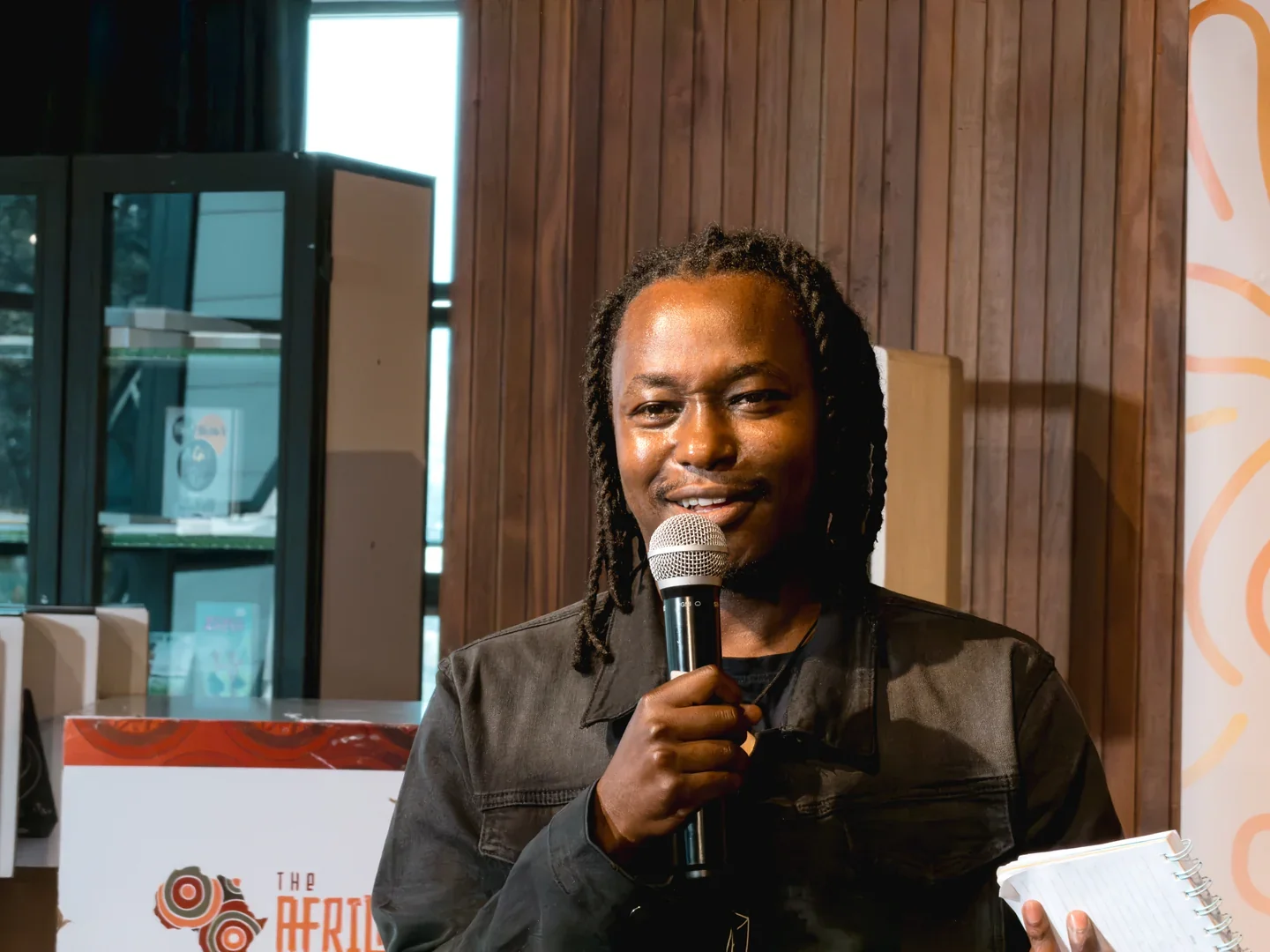
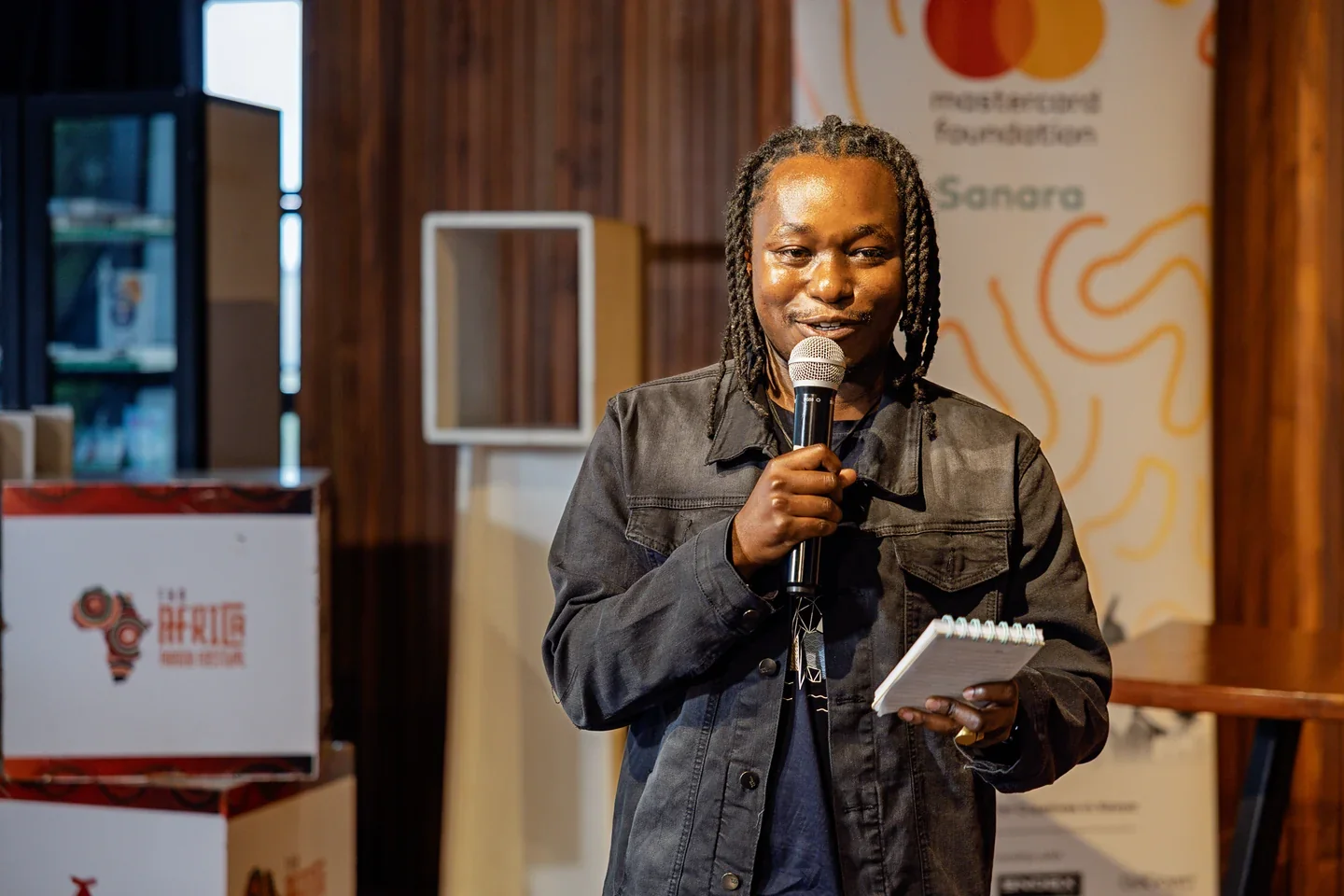
Allan Gitau had a small spiral notebook in one hand and a microphone in the other, and behind him, beside the Sanara banner at Baraza Media Lab, the boxes were already stacked: controllers, studio monitors, headphones. He'd written notes so he wouldn't miss anything. He began, as people do when they're thanking someone for money, with the part where there wasn't any.
“I was telling Joe” - the business developer at Kikuyu Love Sessions - “‘I don't know where we're going to get the money.’ And we had sent out proposals and done what we need to do, but it wasn't forthcoming. Until a DM came in from Pam.”
Pam Mutembei, HEVA Fund's investments director, had told the room her side a few minutes earlier. “I write to many people on Instagram, and they think I'm a scam. I literally send a DM and I say, hi, I work for HEVA, we have this thing and we want to give you money. And you think I'm lying, right? But a gentleman here decided to pick up the call.”
Given current times, the skepticism isn’t entirely out of place - you can throw a stone in any direction and strike a person who knows of a story that started in similar fashion and ended rather differently than Allan’s version.
“I was so quick to respond,” Allan said, “because we were also kind of desperate. And here we are today.”
The Bed
The promise was older than the money, and so was the question behind it. A friend had sent him some Kikuyu R&B, and he'd started asking - later he'd put it to Pulse Live Kenya, the event's media partner - “Why should English be the only language of love?” Saying Nĩngwendete with confidence, he argued, “hits harder than ‘I love you’ in fake British.”
It was nearly called Kikuyu Love Experience, until a friend, Kinandi, said Sessions. The first show drew about eighty people. He spent between KSh 200,000 and 300,000, mostly on the stage, the sound and the artists, and lost it. “We paid them peanuts, honestly. We didn't even make transport money.” Somebody, during setup, called the wooden stage The Bed, and the name stayed with it: there's been a Bed at every show since.
Then the editions came, each with its own name and its own mood. “Our shows are very thematic. They have personalities, and they tell you a story.” Grown-Up, about “being a grown-up emotionally.” Bonded Hearts, with artists paired for duets. Catching Feelings, the one that turned things. More Than Friends in June 2025, the comedian Njugush holding the stage from noon until after midnight, a crowd Allan puts at 3,200, and, for the first time, the books balanced. “From 80 to 3,200,” he told Pulse, “that's not growth, that's grace.”
The people coming through the gate weren't the ones anyone expected for Kikuyu music. “When you walk in, you're not seeing baby boomers. You're just seeing 17-, 18-, up to 24-, 25-year-olds.” Other promoters noticed. New vernacular nights opened. He was glad of them, and then he read their line-ups.
Same faces
“When it comes to artistry, it was just the same faces in all the shows. Especially DJs. And particularly the fact that the DJs who are being booked a lot were all men.”
The women in the booth could have told him why. “Some of the male DJs don't believe that a female DJ can actually do a good job,” says DJ Agger, who would answer his call. “They will deny you maybe a chance that would have changed your life.”
His answer was a campaign rooted in a promoter's logic - find a path towards fixing the bigger problem. “Why can't we run a campaign that will put female vernacular DJs on the map, so that when promoters or curators are coming up with their concepts, at least we can have a bigger pool of DJs to choose from?” It's Her Turn opened at the end of August 2025. DJs sent in a ten-minute video. Finalists' sets were recorded and posted to YouTube, and after twenty-one days the most-watched would win. One winner: a slot at Kikuyu Love Sessions, “which is a big stage,” a new DJ kit, and mentorship from DJ Dibul, “the biggest vernacular DJ currently.” The kit was to come out of the organisers' own pockets. KLS had never had a sponsor.
The submissions startled him. “Many of these girls did not even know each other. It's only after the submissions when we realised, oh my God, look, there are so many female DJs out here.”
Nadia the DJ heard about it from a friend called Violet, who'd been to the sessions; DJ Racey ignored the posters until another DJ phoned her; Agger had learned to market herself from women already in the game.
Just one?
After he answered Pam's message, the two of them got on a video call.
“I was explaining the metrics to Pam. The winner is gonna get a DJing kit, a slot at Kikuyu Love Sessions. Then she's like, ‘Just one?’”
“I was like, ‘Okay, that's how winning works.’”
By the end of the call there was a kit for every finalist, a laptop on top, and training. “I was like, wow. Thank you for seeing that vision, and seeing it even way before we had seen it.”
HEVA's announcement went out at the end of September, six kits and business training through Sanara's partners, and by then the campaign had a new way of describing itself. “This was never designed as a competition,” the organisers said. “It was always a spotlight.”
Three days after the handover, on a phone call in the middle of a working day, he told it again. In that telling HEVA Fund had “taken note of what we were doing,” and come on board, “and that's where we are today.” At Baraza it had been desperation and a direct message, and here we are today. The franker version was the one he gave with the funders sitting in front of him.
The farmer
“My wife is a farmer, so it's a good analogy for her. If a farmer wants good produce, they must cultivate the land, right? They have to make sure that the land is in the best possible position to give the best yield. They don't just throw seeds and then cross fingers that they're going to get good produce.”
“If Kikuyu Love Sessions wants a good show, then we have to support the guys. We want a fire show. Our next show has to be the best show ever. But we can't do that if we are not supporting the upcoming guys. If we just take what is already there, then that is us just throwing seeds and hoping it's going to work. But if we start and then grow together, then our chances of having a more meaningful show are boosted.”
To the money guys
“To the money guys, Sanara, HEVA and all these partners. Those grants that you're talking about, we really do need them badly. Our business model is a bit fragmented, because we've never had a corporate sponsor. But we've found a way to make money without corporate sponsors.”
What he proposed wasn't a cheque for himself. “It doesn't have to be you giving Kikuyu Love Sessions money. It can be you supporting Muringi, who's our star performer, and just paying her directly to come on our stage.” Muringi Matheri has sung at Kikuyu Love Sessions since its earliest editions. Pay the artist, leave the platform its independence, and let the money arrive on stage as a better fee. On the phone, later, he filled in the arithmetic: the musicians he hadn't been able to search for, because “you need studio time, you need trainers”; the rates he'd like to match with the sponsored shows. “Money plays a big, big, big part. Because there's so much we can do, but then we are limited by resources, to be honest.”
The partners had their own sense of scale that afternoon. SNDBX's speaker had told the room the programme had trained some 2,500 creatives across six counties, and that “we are not shouting with our chest yet, but we need to start shouting soon.”
Korea, and Bedford
“When you think about Africa and artistry, the only thing that comes to mind is vernacular. It's our biggest opportunity when it comes to exporting our artists. It's in Luo, it's in Kamba, it's in Kikuyu, it's in Kalenjin. It's the only way we can show who we are to the world.” He lists four languages; his own stage sings in one of them. His evidence comes from the other side of the world. “Even Kenyan kids are watching Korean films on Netflix, because they have some authenticity in their storytelling.”
Korea is a good example and a contested one. South Korea's culture ministry ran a cultural-industry budget of 5.4 billion won in 1994 and 100 billion by 1999, and Seoul is still arguing over whether that money built the wave or only carried its luggage, with K-pop's own executives insisting the industry did it. Allan takes the authenticity from Korea and leaves the budget with the money guys.
The export, for now, travels a particular road. In May 2026 the same DJ Dibul whose mentorship KLS once promised a single winner headlined the Wendo Festival at a rugby club in Bedford, in England, for hundreds of Kenyans living in the UK, under the slogan Ndìmùrehere kìì kuma +254?
Say it with your chest
Back at the microphone, he plugged the next show. They were calling it Say It With Your Chest, set for February, and he gave the six women its title as an instruction. “Use these kits to put yourself out there, and be bold to go for those gigs. No more being in the cocoon.” He asked the partners to localise the training, because the DJs he works with mix Kikuyu music and need, alongside the global view, “someone who understands what the crowd is saying.” He told them it was “way beyond our expectations.”
“There's something I wanted to say, but it's skipped my mind. But it's going to be a challenge that we can keep engaging.”
Sanara is a Mastercard Foundation programme delivered in partnership with HEVA Fund, SNDBX-Ubuntu, Baraza Media Lab and GoDown Arts Centre.